Developing a local instruction theory for the scale concept: A design research study in Indonesian realistic mathematics education contextualized by Bayt Al-Qur'an Al-Akbar
DOI:
https://doi.org/10.31629/jg.v11i1.8003Keywords:
Bayt Al-Qur'an Al-Akbar, design research, Indonesian realistic mathematics education, local instruction theory, scale conceptAbstract
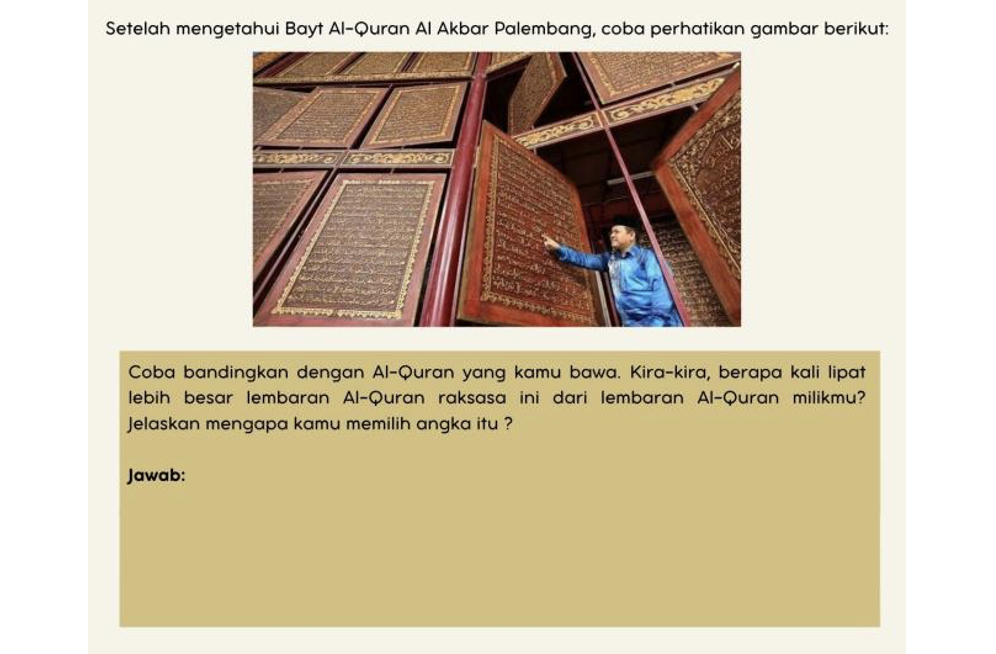
Proportional reasoning is a foundational concept in middle school mathematics. However, many students struggle because they apply additive thinking rather than multiplicative reasoning when faced with abstract, formula-driven instruction. This study aims to develop and validate a local instruction theory (LIT) for the concept of Scales using the realistic context of Bayt Al-Qur'an Al-Akbar. Employing a design research methodology of the validation study type, this research engaged 39 Grade VII students in Palembang, South Sumatra, through a pilot experiment and a main field test. Data was collected through classroom observations, video recordings, and student worksheets and analyzed using a retrospective analysis method. The findings demonstrate that using the giant, non-proportional dimensions of wooden carving successfully triggered critical cognitive conflicts, prompting students to transition from informal estimates to the formal abstraction of a standardized scale factor. This study suggests that large-scale cultural architecture can serve as a tactical pedagogical intervention to subvert procedural misconceptions, offering a transferable framework for locally culture-based mathematics education globally.
Downloads
References
Anderson, L. P., Tupamahu, P. Z., Sabandar, V. P., Makaruku, Y. H., & Sabandar, J. (2024). Realistic mathematics education: Mathematics e-modules in improving student learning outcomes. Infinity, 14(1), 45–64. https://doi.org/10.22460/infinity.v14i1.p45-64
Astuti. (2021). Pengembangan lembar kerja peserta didik (LKPD) berbasis problem-based learning (PBL) untuk kelas VII SMP/MTs mata pelajaran matematika. Jurnal Cendekia: Jurnal Pendidikan Matematika, 5(2), 1011–1024. https://doi.org/10.31004/cendekia.v5i2.573
Bakker, A. (2018). Design research in education: A practical guide for early career researchers. Routledge.
De Lange, J. (2003). Mathematics for literacy. In Quantitative literacy: Why numeracy matters for schools and colleges (pp. 75–89). National Council on Education and the Disciplines.
Febrianto, A., & Sari, T. P. Y. (2024). The influence of contextual teaching and learning on the performance of students studying mathematics. In A. K. Wardana (Ed.), Proceedings of the UPY-ICCCM International Conference on Education and Social Science (UPINCESS 2024) (pp. 165–171). Atlantis Press. https://doi.org/10.2991/978-2-38476-338-2_18
Firsta, R. R., Meryansumayeka, M., Susanti, E., & Zulkardi. (2024). Indonesian realistic mathematics education learning design on the least common multiple, using a calendar context for grade VII students. Jurnal Gantang, 9(2), 173–182. https://doi.org/10.31629/jg.v9i2.6951
Gravemeijer, K., & Cobb, P. (2006). Design research from a learning perspective. In J. van den Akker, K. Gravemeijer, S. McKenney, & N. Nieveen (Eds.), Educational design research (pp. 17–51). Routledge.
Gravemeijer, K., & Terwel, J. (2000). Hans Freudenthal: A mathematician on didactics and curriculum theory. Journal of Curriculum Studies, 32(6), 777–824. https://doi.org/10.1080/00220270050167170
Halimah, H., Riyadi, R., & Atmojo, I. R. W. (2022). Peningkatan keterampilan penalaran matematis melalui pendekatan realistic mathematics education (RME) pada peserta didik kelas V sekolah dasar. Didaktika Dwija Indria, 8(4), 41–46.
Hartati, T., & Gozali, S. M. (2025). Systematic literature review: Students' adaptive reasoning in mathematics learning. Jurnal Gantang, 10(1), 1–10. https://doi.org/10.31629/jg.v10i1.7221
Herlawan, H., Armin, R., & Poa, I. R. (2023). Effectiveness of mathematics learning using the PMRI approach with the assistance of learning videos on students' critical thinking ability. Edumatica: Jurnal Pendidikan Matematika, 13(3), 214–223. https://doi.org/10.22437/edumatica.v13i03.21918
Huzaimah, P. Z., & Risma, A. (2021). Hambatan yang dialami siswa dalam pembelajaran daring matematika pada masa pandemi COVID-19. Jurnal Cendekia: Jurnal Pendidikan Matematika, 5(1), 533–541.
Kurnia, D., Agustiani, R., & Ramury, F. (2023). Hypothetical learning trajectory pada materi perbandingan senilai dengan pendekatan PMRI konteks budaya Sumatera Selatan. JEMST (Journal of Education in Mathematics, Science, and Technology), 6(2), 52–62.
Lutfi, A., Dahlan, J. A., Martadiputra, B. A. P., Jupri, A., Rusyid, H. K., & Mukhibin, A. (2024). Junior high school students' proportional reasoning ability in the domain comparison: A gap in results between indicators. Hipotenusa: Jurnal Riset dan Pengembangan Matematika, 6(1), 1–12. https://doi.org/10.18326/hipotenusa.v6i1.1892
Mulbasari, A. S., Putri, R. I. I., Zulkardi, & Aisyah, N. (2024). Developing a PMRI learning environment for pre-service teachers to teach geometry in elementary education. Jurnal Pendidikan Matematika, 19(3), 585–608. https://doi.org/10.22342/mej.v19i3.pp585-608
Mustakim. (2020). Efektivitas pembelajaran daring menggunakan media online selama pandemi COVID-19 pada mata pelajaran matematika. Al Asma: Journal of Islamic Education, 2(1), 1–12. https://doi.org/10.24252/asma.v2i1.13646
Ndiung, S. (2021). Using the RME principles to support students' problem solving to be HOTS-oriented. In Proceedings of the 1st International Conference on Education, Humanities, Health and Agriculture (ICEHHA 2021). https://doi.org/10.4108/eai.3-6-2021.2310761
Novikasari, I., & Dede, Y. (2023). Toward proficiency: Developing a multiplication mathematical content knowledge test for pre-service mathematics teachers in Indonesia and Türkiye. Journal on Mathematics Education, 15(1), 115–130. https://doi.org/10.22342/jme.v15i1.pp115-130
Plomp, T., & Nieveen, N. (2013). Educational design research. Netherlands Institute for Curriculum Development (SLO).
Prahmana, R. C. I., & D’Ambrosio, U. (2020). Learning geometry and values from patterns: Ethnomathematics on the batik patterns of Yogyakarta, Indonesia. Journal on Mathematics Education, 11(3), 439–456. https://doi.org/10.22342/jme.11.3.11818.439-456
Prahmana, R. C. I., Sagita, L., Hidayat, W., & Utami, N. W. (2020). Two decades of realistic mathematics education research in Indonesia: A survey. Infinity Journal, 9(2), 223–246. https://doi.org/10.22460/infinity.v9i2.p223-246
Prediger, S. (2024). Conjecturing is not all: Theorizing in design research by refining and connecting categorical, descriptive, and explanatory theory elements. EDeR – Educational Design Research, 8(1), 1–30. https://doi.org/10.15460/eder.8.1.2120
Rawani, D., Putri, R. I. I., Zulkardi, & Susanti, E. (2023). The reflective teaching practices using PMRI and collaborative learning. Journal on Mathematics Education, 17(1), 69–88. https://doi.org/10.22342/jpm.17.1.17208.69-88
Rohmah, A. A., Rohim, A., & Asmana, A. T. (2024). Pengaruh strategi pembelajaran aktif berbasis pendekatan PMRI untuk meningkatkan pemahaman konsep siswa. JEDMA: Jurnal Edukasi Matematika, 5(1), 19–29.
Sahara, S., Dolk, M., Hendriyanto, A., Kusmayadi, T. A., & Fitriana, L. (2024). Transformation geometry in eleventh grade using digital manipulative batik activities. Journal on Mathematics Education, 15(1), 55–78. https://doi.org/10.22342/jme.v15i1.pp55-78
Sari, Y. M., Fiangga, S., & El Milla, Y. I. (2023). Exploring students’ proportional reasoning in solving guided- and unguided area conservation problems: A case of Indonesian students. Journal on Mathematics Education, 14(2), 375–394. https://doi.org/10.22342/jme.v14i2.pp375-394
Sari, Y. M., Fiangga, S., El Milla, Y. I., Shahrill, M., & Yanti, L. P. (2025). Prospective teachers’ iceberg designs in realistic mathematics education approach: Connecting mathematics and the SDGs. Journal on Mathematics Education, 16(3), 981–1000. https://doi.org/10.22342/jme.v16i3.pp981-1000
Serepinah, M., & Nurhasanah, N. (2023). Kajian etnomatematika berbasis budaya lokal tradisional ditinjau dari perspektif pendidikan multikultural. Scholaria: Jurnal Pendidikan dan Kebudayaan, 13(2), 148–157.
Setyaningsih, N., & Nurhidayati, M. (2024). Analysis of students’ critical thinking skills in solving algebraic operations HOTS problems reviewed from the logical-mathematical intelligence of junior high school. AIP Conference Proceedings, 2926(1), 020054. https://doi.org/10.1063/5.0183421
Siregar, A. R., Pakpahan, A. F. H., Siregar, E. B., Giawa, F., Siregar, J. M., Ramadhani, N., ... & Hasibuan, R. P. (2024, April). Etnomatematika sebagai sarana penguatan budaya lokal melalui kurikulum merdeka belajar. In Prosiding Mahasaraswati Seminar Nasional Pendidikan Matematika (Vol. 3, No. 1, pp. 44-57).
Siregar, R. N., Suryadi, D., Prabawanto, S., & Mujib, A. (2022). Improving student learning: Mathematical reasoning ability through a realistic mathematics education approach. Aksioma: Jurnal Program Studi Pendidikan Matematika, 11(4), 2698–2710. https://doi.org/10.24127/ajpm.v11i4.6250
Supriadi, P. P., Astutik, H. S., & Pamungkas, D. (2025). Development of student worksheets in the context of local wisdom in mathematics learning. Jurnal Inovasi Pembelajaran Matematika, 6(1), 1–10.
Surgandini, A., Sampoerno, P. D., & Noornia, A. (2019). Pengembangan pembelajaran dengan pendekatan PMRI berbantuan GeoGebra untuk membangun pemahaman konsep transformasi geometri. Prima: Jurnal Pendidikan Matematika, 3(2), 85–102.
Susanti, Y. (2020). Pembelajaran matematika dengan menggunakan media berhitung di sekolah dasar dalam meningkatkan pemahaman siswa. EDISI: Jurnal Edukasi dan Sains, 2(3), 435–448.
Sutarni, S., Sutama, S., Prayitno, H. J., Sutopo, A., & Laksmiwati, P. A. (2024). The development of realistic mathematics education-based student worksheets to enhance higher-order thinking skills and mathematical ability. Infinity, 13(2), 285–300. https://doi.org/10.22460/infinity.v13i2
Tarigan, N. A., & Rakhmawati, F. (2024). Etnomatematika dalam pembuatan tas anyaman Desa Saentis Kabupaten Deli Serdang. Indiktika: Jurnal Inovasi Pendidikan Matematika, 6(2), 210–219.
Tesmeri, L. (2025). Analysis of difficulties in understanding mathematical concepts as seen in the face of students’ metacognitional abilities. EDU RESEARCH, 6(1), 2369–2373. https://doi.org/10.47827/jer.v6i1.1008
Downloads
Published
Issue
Section
License
Copyright (c) 2026 Jurnal Gantang

This work is licensed under a Creative Commons Attribution-NonCommercial-ShareAlike 4.0 International License.