Difficulties faced by junior high school students in solving integer multiplication problems: A Newman’s error analysis approach
DOI:
https://doi.org/10.31629/jg.v11i1.7645Keywords:
difficulties, encoding, integer multiplication, Newman’s error analysis, process skillsAbstract
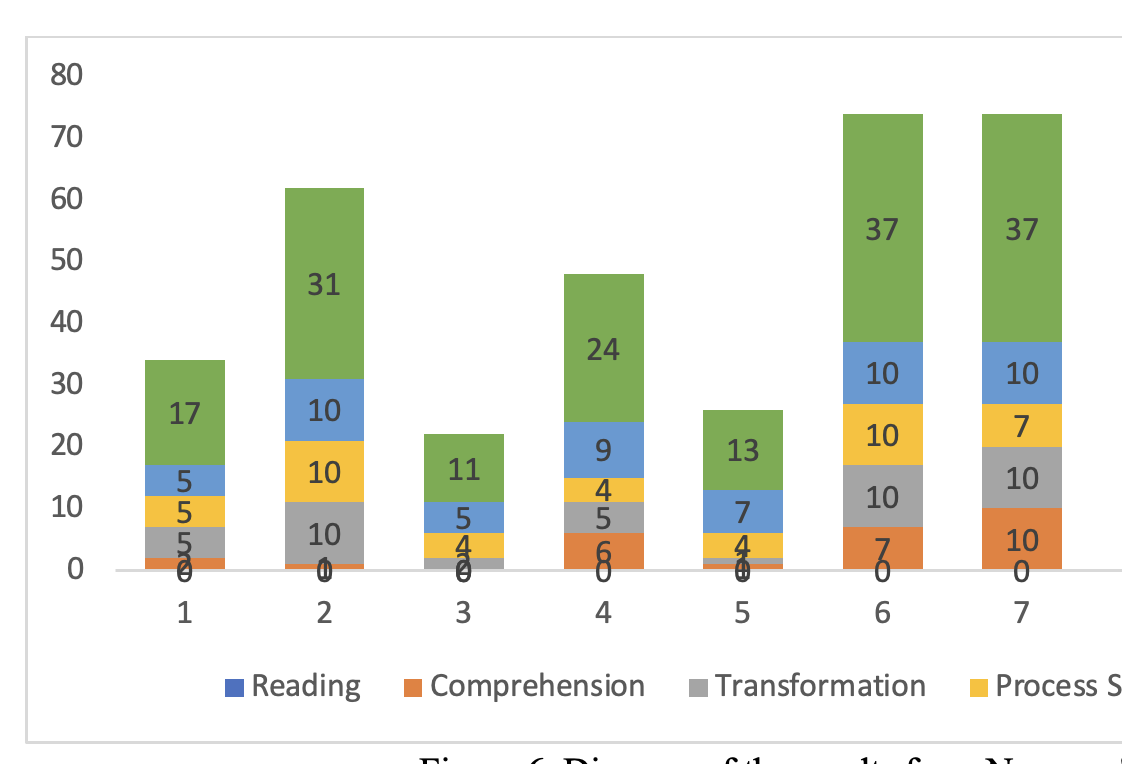
Integer multiplication is a foundational arithmetic competency, yet junior high school students persistently struggle to solve word problems involving it, and these difficulties often go unnoticed when only the correctness of final answers is assessed; consequently, it remains unclear at which cognitive stage students' reasoning actually breaks down. To address this specific problem, this study aims to analyze the types of errors eighth-grade students make when solving integer multiplication problems at a public junior high school in Lembata Regency, East Nusa Tenggara. A qualitative descriptive approach was employed, involving eleven students as participants. The instruments used included a written test consisting of ten questions and an interview guide based on the five stages of Newman's Error Analysis (NEA): reading, comprehension, transformation, process skills, and encoding. The analysis revealed no errors at the reading stage. However, errors were identified at the comprehension stage (10.51%), transformation stage (26.46%), process skills stage (28.79%), and encoding stage (34.24%). The highest error rate occurred during the encoding stage, indicating that although students were able to process the problems correctly, they struggled to express the final answers accurately. These findings suggest that students face challenges related to conceptual understanding, procedural fluency, and mathematical expression. The study highlights the need for instructional strategies that reinforce mastery of foundational skills and enhance students' ability to articulate mathematical ideas precisely.
Downloads
References
Abdullah, A. H., Abidin, N. L. Z., & Ali, M. (2015). Analysis of students' errors in solving higher order thinking skills (HOTS) problems on the topic of fractions. Asian Social Science, 11(21), 133–144. https://doi.org/10.5539/ass.v11n21p133
Ahmadi, Y., Kusumah, Y. S., & Jupri, A. (2019). Analysis of high school students’ errors in mathematical proving: The case of mathematical induction. Journal of Physics: Conference Series, 1211(1), 012068. https://doi.org/10.1088/1742-6596/1211/1/012068
Alfarisi, M. A., Dasari, D., Jupri, A., & Sikma, Y. (2022). Is the integer number difficult for students? A systematic literature review. AIP Conference Proceedings, 2614, 070030. https://doi.org/10.1063/5.0102934
Arifin, S., Zulkardi, Ilma, R. I. P., & Hartono, Y. (2021). Analisis kemampuan pemecahan masalah siswa SMP ditinjau dari kemampuan memahami, merencana, dan menyelesaikan masalah. Jurnal Gantang, 6(1), 29–38. https://doi.org/10.31629/jg.v6i1.3050
Bahbah, A., & Erradi, M. (2024). Assessment of mathematical problem-solving skills in the college cycle in Morocco: A tripartite exploration across various mathematical disciplines. Palestine Journal of Mathematics, 13(Special Issue I), 22–35.
Clements, M. A., & Ellerton, N. F. (1992). Overemphasizing process skills in school mathematics: Newman error analysis data from five countries. In W. Geeslin & K. Graham (Eds.), Proceedings of the 16th Annual Conference of the International Group for the Psychology of Mathematics Education (Vol. 2, pp. 145–152).
Eddahab-Burke, F.-Z. A., & Okur, Ö. (2025). Dignified engineering education: An introduction. In 2025 IEEE Global Engineering Education Conference (EDUCON) (pp. 1–7). https://doi.org/10.1109/EDUCON62633.2025.11016624
González, G. (2017). Teachers’ understandings of realistic contexts to capitalize on students’ prior knowledge. School Science and Mathematics, 117(7–8), 329–340. https://doi.org/10.1111/ssm.12249
Harun, N. A., Cuevas, K. G., Asakil, O. I., Alviar, J. V., & Solon, L. J. V. (2023). Assessing students’ mastery and misconceptions in the fundamental operations on integers. International Journal of Science, Technology, Engineering and Mathematics, 3(3), 36–55. https://doi.org/10.53378/353000
Hidayah, I. R., Sa’dijah, C., Anwar, L., Yerizon, Y., & Arnawa, I. M. (2024). Empowering students’ numeracy skills: Mathematics teachers’ perceptions regarding the effectiveness and challenges of the Indonesian national curriculum and its programs: A mixed-method study. Infinity Journal, 14(1), 163–188. https://doi.org/10.22460/infinity.v14i1.p163-188
Hiebert, J., & Lefevre, P. (1986). Conceptual and procedural knowledge in mathematics: An introductory analysis. In J. Hiebert (Ed.), Conceptual and procedural knowledge: The case of mathematics (pp. 1–27). Lawrence Erlbaum Associates.
Kurniati, N., Prabawanto, S., & Haeruddin, H. (2022). Analisis kesalahan siswa kelas VII terhadap konsep perkalian beserta rekomendasi desain pembelajaran konsep perkalian. Jurnal Pembelajaran Matematika Inovatif, 5(6), 1703–1714. https://doi.org/10.22460/jpmi.v5i6.1703-1714
Kusmayadi, T. A., Sahara, S., & Fitriana, L. (2022). Application of Newman errors analysis theory related to mathematical literacy problems: A case study of secondary students in class 11. AIP Conference Proceedings, 2614, 020013. https://doi.org/10.1063/5.0117183
Kusumadewi, C. A., & Retnawati, H. (2020). Identification of elementary school students’ difficulties in mathematical problem-solving. Journal of Physics: Conference Series, 1511(1), 012031. https://doi.org/10.1088/1742-6596/1511/1/012031
Lubis, M. N., & Jupri, A. (2023). Analysis of student errors in solving word problems on linear programming using Newman’s procedure. AIP Conference Proceedings, 2614, 090018. https://doi.org/10.1063/5.0156385
Makgakga, T. P. (2023). Solving quadratic equations by completing the square: Applying Newman's error analysis model to analyze Grade 11 errors. Pythagoras, 44(1). https://doi.org/10.4102/pythagoras.v44i1.742
Mayer, R. E. (1992). Thinking, problem solving, cognition (2nd ed.). W. H. Freeman.
Mubarokah, A. A. L., & Amir, M. F. (2024). Primary students’ errors in solving mathematical literacy problems based on Newman analysis. Mathematics Education Journal, 18(2), 217–230. https://doi.org/10.22342/jpm.v18i2.pp217-230
Newman, M. A. (1977). An analysis of sixth-grade pupils’ errors on written mathematical tasks. Victorian Institute for Educational Research Bulletin, 39, 31–43.
Newman, M. A. (1983). Strategies for diagnosis and remediation. Harcourt Brace.
Nofrianto, A., Gulo, A. D. C., Amri, M. A., & Rafulta, E. (2022). Student errors in mathematics word problems: What can be learned? Jurnal Gantang, 7(1), 59–67. https://doi.org/10.31629/jg.v7i1.4426
Organisation for Economic Co-operation and Development. (2023). PISA 2022 results (Volume I): The state of learning and equity in education. OECD Publishing. https://doi.org/10.1787/53f23881-en
Priliawati, E., Slamet, I., & Sujadi, I. (2019). Analysis of junior high school students’ errors in solving HOTS geometry problems based on Newman’s error analysis. Journal of Physics: Conference Series, 1321(3), 032131. https://doi.org/10.1088/1742-6596/1321/3/032131
Reinke, L. T. (2019). Toward an analytical framework for contextual problem-based mathematics instruction. Mathematical Thinking and Learning, 21(4), 265–284. https://doi.org/10.1080/10986065.2019.1576004
Rittle-Johnson, B., Schneider, M., & Star, J. R. (2015). Not a one-way street: Bidirectional relations between procedural and conceptual knowledge of mathematics. Educational Psychology Review, 27(4), 587–597. https://doi.org/10.1007/s10648-015-9302-x
Rosyidah, A. N. K., Maulyda, M. A., Jiwandono, I. S., Oktaviyanti, I., & Gunawan, G. (2021). Misconceptions and errors in integer operations: A study in preservice elementary school teachers (PGSD). Journal of Physics: Conference Series, 1779(1), 012078. https://doi.org/10.1088/1742-6596/1779/1/012078
Shinariko, L. J., Saputri, N. W., Hartono, Y., & Araiku, J. (2020). Analysis of students’ mistakes in solving mathematics olympiad problems. Journal of Physics: Conference Series, 1480(1), 012039. https://doi.org/10.1088/1742-6596/1480/1/012039
Stålne, K., Kjellström, S., & Utriainen, J. (2016). Assessing complexity in learning outcomes: A comparison between the SOLO taxonomy and the model of hierarchical complexity. Assessment & Evaluation in Higher Education, 41(7), 1033–1048. https://doi.org/10.1080/02602938.2015.1047319
Suradi, & Djam’an, N. (2021). Students’ error on proof of the group with “satisfy axioms proof” based on Newman error analysis. Journal of Physics: Conference Series, 2123(1), 012024. https://doi.org/10.1088/1742-6596/2123/1/012024
Sweller, J., van Merriënboer, J. J. G., & Paas, F. (2019). Cognitive architecture and instructional design: 20 years later. Educational Psychology Review, 31(2), 261–292. https://doi.org/10.1007/s10648-019-09465-5
Triliana, T., & Asih, E. C. M. (2019). Analysis of students’ errors in solving probability based on Newman’s error analysis. Journal of Physics: Conference Series, 1211(1), 012061. https://doi.org/10.1088/1742-6596/1211/1/012061
White, A. L. (2010). Numeracy, literacy and Newman’s error analysis. Journal of Science and Mathematics Education in Southeast Asia, 33(2), 129–148.
Downloads
Published
Issue
Section
License
Copyright (c) 2026 Jurnal Gantang

This work is licensed under a Creative Commons Attribution-NonCommercial-ShareAlike 4.0 International License.