Developing PBL-based worksheets on sequences and series to enhance mathematical connection skills of senior high school students
DOI:
https://doi.org/10.31629/8kyexw71Keywords:
student worksheet, problem-based learning, mathematical connection ability, sequences and seriesAbstract
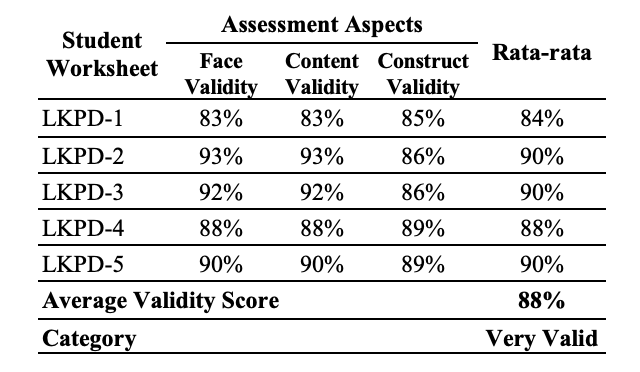
This study was driven by students’ low mathematical connection ability in learning Sequences and Series, a skill essential for understanding relationships among mathematical concepts. The purpose of this research was to develop a Problem-Based Learning (PBL)-based student worksheet designed to improve students’ mathematical connection ability and to examine its validity and practicality. A development research approach was applied using the 4-D model—Define, Design, Develop, and Disseminate. The participants were tenth-grade students selected through purposive sampling. Data were collected using validation instruments, practicality questionnaires, interviews, and classroom observations. The validation process evaluated face, content, and construct validity. The developed worksheet demonstrated strong validity, with average scores of 89.29% for face validity, 89.29% for content validity, and 86.79% for construct validity. The overall validity score of 88.45% fell into the “very valid” category, indicating the product’s suitability for field implementation. The practicality assessment, focusing on design, clarity of material presentation, and ease of use, produced an average score of 83.27%, classified as “practical.” These findings suggest that the PBL-based worksheet is both valid and practical, offering potential as an effective instructional tool to support students in developing mathematical connection ability, particularly in topics related to Sequences and Series.
Downloads
References
Abidin, Z. (2020). Efektivitas pembelajaran berbasis masalah, pembelajaran berbasis proyek literasi, dan pembelajaran inkuiri dalam meningkatkan kemampuan koneksi matematis. Profesi Pendidikan Dasar, 1(1), 37–52. https://doi.org/10.23917/ppd.v1i1.10736
Akbar, S. (2017). Instrumen perangkat pembelajaran. Remaja Rosda Karya.
Aneliana, A. (2022). The development of a student worksheet based on Problem-Based Learning to improve critical thinking skills. Brillo Journal.
Astuti, N. W., & Octavia, B. (2023). Development of Problem-Based Student Worksheet on Environmental Change Material. Jurnal Penelitian Pendidikan IPA, 9(12), 10916-10922.
Atiningsih, S. M. (2018). Penerapan model problem-based learning untuk meningkatkan kemampuan koneksi matematika dan tanggung jawab peserta didik pada kelas XI semester 1 tahun 2015/2016 SMA N 11 Semarang. Journal of Medives, 2, 77–86.
Ayuningtyas, A. D., & Setiana, D. S. (2019). Pengembangan bahan ajar matematika berbasis etnomatematika Kraton Yogyakarta. AKSIOMA: Jurnal Program Studi Pendidikan Matematika, 8(1). https://doi.org/10.24127/ajpm.v8i1.1630
Baiduri, O. R., Putri, I. A., & Alfani, I. (2020). The mathematics connection process of students with low mathematical ability in solving contextual problems. European Journal of Educational Research, 9(4), 1527–1541. https://doi.org/10.12973/eu-jer.9.4.1527
Bernard, M., & Senjayawati, E. (2019). Meningkatkan kemampuan koneksi matematik siswa SMP dengan menggunakan pendekatan metaphorical thinking berbantuan software geogebra. Jurnal Mercumatika: Jurnal Penelitian Matematika Dan Pendidikan Matematika, 3(2). https://doi.org/10.26486/jm.v3i2.558
Chen, T., Zhao, Y.-J., Huang, F.-Q., Liu, Q., Li, Y., Alolga, R. N., Zhang, L., & Ma, G. (2024). The effect of problem-based learning on improving problem-solving, self-directed learning, and critical thinking ability for the pharmacy students: A randomized controlled trial and meta-analysis. PLOS ONE, 19(12). https://doi.org/10.1371/journal.pone.0314017
Dalimunthe, Y & Hasibuan, I. S. (2025). Development of learning problem-based learning to increase mathematical connection ability students of SMK Darul Arqom Kerasaan. International Journal of Humanities Education and Social Sciences (IJHESS), 4(4). https://doi.org/10.55227/ijhess.v4i4.151
Effendi, R., Herpratiwi, H., & Sutiarso, S. (2021). Pengembangan LKPD matematika berbasis problem based learning di Sekolah Dasar. Jurnal Basicedu, 5(2), 920–929. https://doi.org/10.31004/basicedu.v5i2.846
Engelbrecht, J., Llinares, S., & Borba, M. C. (2020). Transformation of the mathematics classroom with the internet. ZDM, 52(5), 825–841. https://doi.org/10.1007/s11858-020-01176-4
Eryani, R. (2025). Needs analysis for PBL-based mathematics student worksheets. JELE Journal.
Ge, W.-L., Zhu, X.-Y., Lin, J.-B., Jiang, J.-J., Li, T., Lu, Y.-F., Mi, Y.-F., & Tung, T.-H. (2025). Critical thinking and clinical skills by problem-based learning educational methods: an umbrella systematic review. BMC Medical Education, 25(1), 455. https://doi.org/10.1186/s12909-025-06951-z
Gravemeijer, K., Stephan, M., Julie, C., Lin, F.-L., & Ohtani, M. (2017). What mathematics education may prepare students for the society of the future? International Journal of Science and Mathematics Education, 15(S1), 105–123. https://doi.org/10.1007/s10763-017-9814-6
Haji, S. (2017). Developing students’ mathematical connection ability using outdoor mathematics learning. Infinity Journal.
Hariyomurti, B., Prabawanto, S., & Al Jupri, D. (2020). Learning obstacle siswa dalam pembelajaran barisan dan deret aritmetika. In Journal for Research in Mathematics Learning) p (Vol. 3, Issue 3).
Hasbi, M. (2019). Improving the mathematical connection ability of middle school students through problem-based learning. Journal of Mathematics Education, 11(3), 123–136.
Hasibuan, S. A. (2020). Development of PISA mathematical problem model on the change and relationship content. International Electronic Journal of Mathematics Education, 15(1), 1–9. https://eric.ed.gov/?id=EJ1235422
Hayati, H. S., Astuti, P., & Febrian, F. (2022). Electronic student worksheets based on rigorous mathematical thinking for sequence and series materials in senior high school. Jurnal Gantang, 7(2).
Juniati, J., Kartini, K., & Maimunah, M. (2021). Perangkat pembelajaran materi segiempat dan segitiga berbasis model pbl untuk memfasilitasi kemampuan koneksi matematis peserta didik SMP/MTs. Jurnal Cendekia, 5(2), 1375–1389. https://doi.org/10.31004/cendekia.v5i2.545
Khoirudin, A., Setyawati, R. D., & Nursyahida, F. (2017). Profil kemampuan literasi matematika siswa berkemampuan matematis rendah dalam menyelesaikan soal berbentuk PISA (Vol. 8, Issue 2). https://doi.org/https://doi.org/10.26877/aks.v8i2.1839
Lestari, P., Mardiyana, M., & Slamet, I. (2022). Effectiveness of mathematics modules based on problem-based learning to improve students’ reasoning ability in junior high school. Muslim Education Review, 1(2), 198–213. https://doi.org/10.56529/mer.v1i2.77
Lestary, V. S., Zulfah, & Astuti. (2023). Analisis bibliometrik: Fokus penelitian problem based learnig dalam pembelajaran matematika. Jurnal Ilmiah Matematika Realistik , 120–125.
Lina, S. I., Johar, R., & Anwar. (2025). The role of mathematics education in shaping sustainable futures: A systematic literature review. Jurnal Elemen, 11(3), 757–782. https://doi.org/10.29408/jel.v11i3.29706
Lonergan, R., Cumming, T. M., & O’Neill, S. C. (2022). Exploring the efficacy of problem-based learning in diverse secondary school classrooms: Characteristics and goals of problem-based learning. International Journal of Educational Research, 112, 101945. https://doi.org/10.1016/j.ijer.2022.101945
Mahendra, Y. M., Husamah, H., & Budiono, B. (2023). Improving mathematical connection capability and learning outcomes through problem-based learning model. AlphaMath: Journal of Mathematics Education, 9(1), 61. https://doi.org/10.30595/alphamath.v9i1.17308
Mandasari, N. (2021). Problem-based learning model to improve mathematical reasoning ability. Journal of Physics: Conference Series, 1731(1), 012041. https://doi.org/10.1088/1742-6596/1731/1/012041
Manuaba, I. B. A. P., -No, Y., & Wu, C.-C. (2024). Correction: The effectiveness of problem-based learning in improving critical thinking, problem-solving and self-directed learning in first-year medical students: A meta-analysis. PLOS ONE, 19(5), e0303724. https://doi.org/10.1371/journal.pone.0303724
Masruroh, V. (2023). Development of student worksheets oriented to Problem-Based Learning integrated 21st century skills. Alishlah Journal.
Mubarika, M. P., Firmansyah, E., & Yulianie, L. (2020). Implementasi dimensi connectedness dalam problem-based learning untuk meningkatkan koneksi matematis dan disposisi matematis. Pasundan Journal of Mathematics Education: Jurnal Pendidikan Matematika, 10(1), 39–50. https://doi.org/10.23969/pjme.v10i1.2443
Noprinda, C. T., & Soleh, S. M. (2019). Pengembangan lembar kerja peserta didik (LKPD) berbasis higher order thinking skill (hots). Indonesian Journal of Science and Mathematics Education, 2(2), 168–176. https://doi.org/10.24042/ijsme.v2i2.4342
Nuryanti, D., & al., et. (2018). Students’ difficulties in solving PISA-like problems: implications for mathematical connections. International Journal of Research & Method in Education, 41(2), 123–139.
OECD. (2019). PISA 2018 Results (Volume I): What students know and can do. OECD Publishing. https://doi.org/10.1787/5f07c754-en
Permatasari, S., Asikin, M., & Dewi, N. R. (2020). Potensi game edukasi untuk mengembangkan kemampuan koneksi matematis siswa pada pembelajaran daring. Prosiding Seminar Nasional Pascasarjana.
Permendikbudristek. (2022). Permendikbud Nomor 008 Tahun 2022 tentang Capaian Pembelajaran Pada Pendidikan Anak Usia Dini, Jenjang Pendidikan Menengah Pada Kurikulum Merdeka.
Pradini, M. R., Lusiana, L., & Kesumawati, N. (2022). Problem based learning and self-regulated learning: Impact on mathematical reasoning ability in the circle material. Desimal: Jurnal Matematika, 5(3), 235–246. https://doi.org/10.24042/djm.v5i3.12807
Purnama, D. M., Widyatiningtyas, R., & Ridha, M. R. (2019). Penerapan model pembelajaran learning cycle 5e untuk meningkatkan kemampuan koneksi matematis siswa SMK. INTERMATHZO, 4, 9–18.
Putri, H. E. (2017). Pendekatan concrete-pictorial-abstract (CPA), kemampuan kemampuan matematis, dan rancangan pembelajarannya. UPI Sumedang Press.
Putri, R. I., & Santosa, R. H. (2015). Keefektifan strategi REACT ditinjau dari prestasi belajar, kemampuan penyelesaian masalah, koneksi matematis, self-efficacy. Jurnal Riset Pendidikan Matematika, 2(2), 262–272. https://doi.org/10.21831/jrpm.v2i2.7345
Ratuanik, M., Sainlia, B., Batkunde, Y., Nifanngelyau, J., Matematika, P., Tinggi Keguruan Dan Ilmu Pendidikan Saumlaki, S., & Boediono-Saumlaki, J. (2022). Model Pembelajaran Problem Based Learning untuk Meningkatkan Pemecahan Masalah Matematika SMP Santo Paulus Saumlaki. Leibniz: Jurnal Matematika, 2, 34. https://doi.org/https://doi.org/10.59632/leibniz.v2i1.139
Retnawati, H., Apino, E., & Santoso, A. (2020). High school students’ difficulties in making mathematical connections when solving problems. International Journal of Learning, Teaching and Educational Research, 19(8), 255–277. https://doi.org/10.26803/ijlter.19.8.14
Rohendi, D., & Dulpaja, J. (2013). Connected Mathematics Project (CMP) model based on presentation media to the mathematical connection ability of junior high school student. Journal of Education and Practice, 4(4). www.iiste.org
Saputra, I., Armis, & Maimunah. (2022). Pengembangan perangkat pembelajaran matematika berbasis discovery learning untuk memfasilitasi kemampuan koneksi matematis peserta didik. ANARGYA: Jurnal Ilmiah Pendidikan Matematika, 43–52.
Satiti, W. S., Fajariyah, L., & Nasrulloh, M. F. (2023). Development of occupational-based-context worksheets of geometric sequences and series for senior high school students. APPLICATION: Applied Science in Learning Research, 2(3), 143–149.
Setiawan, W., Tahmir, S., & Jafaruddin, J. (2024). The effect of problem-based learning on mathematical connection ability in the context of learning style at UPT SMAN 6 Jeneponto. Formatif: Jurnal Ilmiah Pendidikan MIPA, 14(2). https://doi.org/10.30998/formatif.v14i2.28949
Sholeha, V. A., Risnawati, & Habibullah. (2021). An analysis of student difficulties in mathematics learning in terms of mathematical connection ability on Pythagoras theorem. Prisma, 10(2), 45–60.
Sudirman, C., & Kadir. (2018). Analisis kemampuan koneksi matematis siswa smp pesisir ditinjau dari perbedaan gender. Jurnal Pembelajaran Berpikir Matematika, 3, 656–680.
Suryanti, E. (2023). Development of student worksheets based on Problem-Based Learning with video-assisted approach. JPPIpa.
Tambunan, S. P. R., & Khairuna, K. (2024). Development of problem-based learning worksheets combined with the make a match cooperative model to enhance students' critical thinking skills in biology. Jurnal EDUCATIO: Jurnal Pendidikan Indonesia, 10(1), 322-333.
Tasni, N. (2020). Students’ difficulties in productive connective thinking to solve mathematical problems. Beta: Jurnal Tadris Matematika, 13(2), 45–58.
Triwahyudianto, T., Isnani, D. R., & Kumala, F. N. (2024). PBL-based liveworksheet e-LKPD to improve critical thinking ability in primary science learning. Jurnal Bidang Pendidikan Dasar, 8(1), 96–104.
Tussholeha, Z. (2023). Student worksheets (LKPD) with problem-based learning model: Development and validity. AlphaMath: Journal of Mathematics Education, 7(2), 92–100.
Widyawati, S., Rosydah, U., Setyawati, A., & Lestari, S. (2025). Evaluating the CMP model's impact on mathematical connection abilities: Insights through self-efficacy levels. Al-Jabar: Jurnal Pendidikan Matematika, 16(1).
Widiyawati, W., Septian, A., & Inayah, S. (2020). Analisis kemampuan koneksi matematis siswa SMK pada materi trigonometri. Jurnal Analisa, 6(1), 28–39. https://doi.org/10.15575/ja.v6i1.8566
Yew, E. H. J., & Goh, K. (2016). Problem-based learning: An overview of its process and impact on learning. Health Professions Education, 2(2), 75–79. https://doi.org/10.1016/j.hpe.2016.01.004
Yu, L., & Zin, Z. M. (2023). The critical thinking-oriented adaptations of problem-based learning models: A systematic review. Frontiers in education, 8. https://doi.org/10.3389/feduc.2023.1139987
Downloads
Published
Issue
Section
License
Copyright (c) 2025 Jurnal Gantang

This work is licensed under a Creative Commons Attribution-NonCommercial-ShareAlike 4.0 International License.