Improving elementary school students' mathematical problem-solving skills: The effectiveness of realistic mathematics education with problem-based learning
DOI:
https://doi.org/10.31629/78np8r24Keywords:
realistic mathematics education, problem-based learning, mathematical problem-solving skills, elementary school, quasi-experimentalAbstract
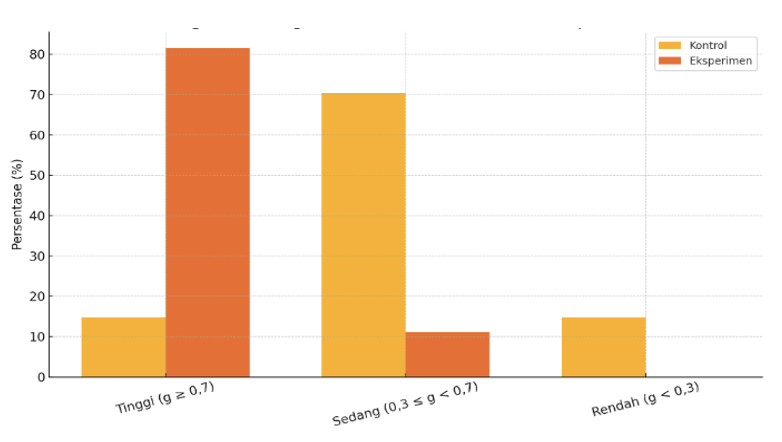
Mathematics education in Indonesian elementary schools faces significant challenges in developing students' problem-solving skills, as evidenced by the 2022 PISA results, which showed that only 18% of Indonesian students achieved the minimum proficiency level, far below the OECD average. This study aims to evaluate the effectiveness of integrating the Realistic Mathematics Education (RME) approach with Problem-Based Learning (PBL) to enhance fourth-grade students' mathematical problem-solving skills in Bekasi Regency. A quasi-experimental design with a nonequivalent control group was employed, involving 52 students selected through cluster random sampling. The experimental class received RME-based PBL instruction, while the control class received PBL instruction based on the scientific approach. Data were collected using a validated problem-solving essay test and analyzed using descriptive and inferential statistics, including independent-samples t-tests and normalized gain scores. The results demonstrated that the RME-PBL approach significantly improved students' problem-solving skills across all measured aspects: problem identification, formulation, strategy application, and result explanation. Notably, 92% of students in the experimental class achieved good or very good categories, compared to only 22.22% in the control class. The normalized gain for the experimental class was 0.81 (high category), substantially higher than the control class's 0.41 (moderate category). It is concluded that the RME-PBL approach is significantly more effective than the scientific-PBL approach in enhancing elementary students' mathematical problem-solving abilities.
Downloads
References
Amar, R. Z., Usmar, A., & Wendra, B. (2022). Pengaruh penggunaan lembar kerja peserta didik berbasis realistic mathematic education terhadap hasil belajar siswa. Jurnal Lebesgue : Jurnal Ilmiah Pendidikan Matematika, Matematika Dan Statistika, 3(1), 69–77. https://doi.org/10.46306/lb.v3i1.82
Amir, F., Firdaus F. M., & Pada, A. (2024). How does realistic mathematics learning shape learners' problem-solving and critical-thinking skills? AL-ISHLAH: Jurnal Pendidikan, 16(3), 3588–3602. https://doi.org/10.35445/alishlah.v16i3.5101
Cahyaningsih, U., & Nahdi, D. S. (2020). Pengembangan bahan ajar matematika sd berbasis model pembelajaran realistic mathematics education yang berorientasi kemampuan berpikir kritis. Journal Educatio FKIP UNMA, 6(2), 598–604. https://doi.org/10.31949/educatio.v6i2.622
Cahyaningsih, U., & Nahdi, D. S. (2021). The effect of realistic mathematics education on elementary students’ critical thinking skills. Journal of Physics: Conference Series, 1764(1). https://doi.org/10.1088/1742-6596/1764/1/012127
Daulay, L., Yustinaningrum, B., Pasaribu, F. T., Manurung, S. L., & Putri, E. (2025). Development of a contextual worksheet based on the comic on systems of linear equations in two variables. Journal Mathema, 7(1), 1–10. https://doi.org/10.15548/jt.v32i2.986
Firsta, R. R., Meryansumayeka, M., Susanti, E., & Zulkardi, Z. (2024). Indonesian realistic mathematics education learning design for the least common multiple material using a calendar context for grade VII students. Jurnal Gantang, 2, 205–214. https://doi.org/10.31629/jg.v9i2.6951
Fitriani, E., & Fauzi, A. (2024). Meningkatkan keterampilan berpikir kritis dengan model. Jurnal Ilmiah Pendidikan Dasar, 09(04), 2548–6950.
Hasyanah, Y., Sukmaningthias, N., & Nuraeni, Z. (2023). Pengaruh digital komik berbasis realistic mathematic education terhadap kemampuan pemecahan masalah. JTMT: Journal Tadris Matematika, 4(1), 56–65. https://doi.org/10.47435/jtmt.v4i1.1750
Jacoby, A. J. P., & Ael, K. V. (2021). Bringing systemic design into the educational practice: The case of gender equality in an academic context. Proceedings of the Design Society, 1(AUGUST), 581–590. https://doi.org/10.1017/pds.2021.58
Jadidah, T. I., Annisah, R., Anggilin, K., & Melinda, M. (2023). Analisis implikasi pembelajaran matematika SD menurut teori jean piaget. JDER Journal of Dehasen Education Review, 2023(2), 139–144. https://doi.org/10.33258/joder.v4i02.4256
Khotimah, K., & Mahmudah, A. (2021). Math learning with realistic mathematics education approach based on open-ended problems. APPLICATION: Applied Science in Learning Research, 1(1), 13–22. https://doi.org/10.32764/application.v1i1.1422
Korompis, F. L. S. (2023). Piaget’s theory in mathematics education in elementary school. International Journal of Research and Review, 10(6), 82–92. https://doi.org/10.52403/ijrr.20230612
Luiz, R. B., Estevam, L. O., Raponi, M. B. G., Felix, M. M. D. S., & Barbosa, M. H. (2022). Efficacy of educational strategies in patient involvement for safety in care: a systematic review. Revista Gaucha de Enfermagem, 43(Special Issue), 1–15. https://doi.org/10.1590/1983-1447.2022.20210198.en
Maslihah, S., Waluya, S. B., Rochmad, K., Karomah, N., & Iqbal, K. (2021). Increasing mathematical literacy and learning independence through a problem-based learning model with a realistic mathematical education approach. Journal of Physics: Conference Series, 1918(4). https://doi.org/10.1088/1742-6596/1918/4/042123
Meltzer, D. E. (2002). The relationship between mathematics preparation and conceptual learning gains in physics: A possible “hidden variable” in diagnostic pretest scores. American Journal of Physics, 70(12), 1259–1268. https://doi.org/10.1119/1.1514215
Miharja, M. A., Bulayi, M., Viet, L., & Triet, M. (2024). Realistic mathematics education : unlocking problem-solving potential in students. Indonesian Journal of Mathematical Edication, 2(1), 50–59. https://doi.org/10.37251/ijome.v2i1.1344
Mukaromah, M., Parmin, P., & Prastiti, T. D. (2023). Effectiveness of realistic mathemathic education (RME) model assisted with jarimatics on student problem solving. Mathline : Jurnal Matematika Dan Pendidikan Matematika, 8(4), 1589–1600. https://doi.org/10.31943/mathline.v8i4.538
Nurhidayah, N., & Yahya, A. (2023). Implementation of the merdeka curriculum through the application of the project-based blended learning model in mathematics learning. MaPan, 11(2), 273–284. https://doi.org/10.24252/mapan.2023v11n2a5
OECD. (2023). PISA 2022 Results Factsheets Indonesia. OECD (Organisation for Economic Co-Operation and Development) Publication, 1–9.
Palinussa, A. L., Dias, T. C., & Ngilawajan, D. A. (2021). The effect of realistic mathematics education and problem based learning model on mathematics problem solving ability in terms of precondition mathematics abilities. Proceedings of the 1st International Conference on Mathematics and Mathematics Education (ICMMEd 2020), 550(Icmmed 2020), 488–491. https://doi.org/10.2991/assehr.k.210508.109
Pratiwi, W. D., Ilma, R., Putri, I., & Hiltrimartin, C. (2024). Developing problem-based learning worksheet of relations and functions topic to support students ’ conceptual understanding. Jurnal Gantang, 2, 255–264. https://doi.org/10.31629/jg.v9i2.6958
Rohmah, I. N., & Jupri, A. (2024). The effectiveness of mathematics learning through a realistic mathematics education approach in elementary schools. Jurnal Cakrawala Pendas, 10(3), 500–511. https://doi.org/10.31949/jcp.v10i3.9472
Scristia, S., Herman, T., Sholihat, M. N., & Sari, N. (2024). Development of an interactive E-Module based on realistic mathematics education ( RME ) to enhance students ’ mathematical reasoning skills on parallel lines and angles. Jurnal Gantang, 2, 229–242. https://doi.org/10.31629/jg.v9i2.6955
Sutarni, S., & Aryuana, A. (2023). Realistic mathematics education (RME): Implementation of learning models for improving hots-oriented mathematics problem-solving ability. AL-ISHLAH: Jurnal Pendidikan, 15(2), 1213–1223. https://doi.org/10.35445/alishlah.v15i2.2127
Tumangger, W. R., Khalil, I. A., & Prahmana, R. C. I. (2024). The impact of realistic mathematics education-based student worksheet for improving students’ mathematical problem-solving skills. IndoMath: Indonesia Mathematics Education, 7(2), 196. https://doi.org/10.30738/indomath.v7i2.122
Umar, U. P. S., & Zakaria, Z. (2022). The effectiveness of the realistic math education (RME) learning method based on manipulative media in improving the problem-solving abilities of elementary school students. Ekspose: Jurnal Penelitian Hukum Dan Pendidikan, 21(1), 1369–1376. https://doi.org/10.30863/ekspose.v21i1.3405
Umi, F., Yerizon, Y., Syarifuddin, H., Desyandari, D., & Fitria, Y. . . (2020). The Development of realistic mathematics education (RME) based mathematics learning tools to improve problem solving ability in elementary school. Jurnal Pendidikan Al-Ishlah, 16(3), 3310–3321. https://doi.org/10.35445/alishlah.v16i3.4293
Widodo, S., Santia, I., & Katminingsih, Y. (2023). Increasing students’ mathematical problem solving ability through realistic mathematics education (RME). International Journal of Research and Review, 10(1), 68–76. https://doi.org/10.52403/ijrr.20230109
Yulaichah, S., Mariana, N., & Wiryanto, W. (2024). The Use of e-comics based on a realistic mathematical approach to improve critical and creative thinking skills of elementary school students. IJORER : International Journal of Recent Educational Research, 5(1), 90–105. https://doi.org/10.46245/ijorer.v5i1.497
Zuhriyah, S. (2024). Pengaruh kemampuan koneksi matematis terhadap kesulitan belajar siswa melalui penerapan RME di MTs Zainul Anwar. SEMESTA: Jurnal Ilmu Pendidikan Dan Pengajaran, 2(3), 141–148. https://doi.org/10.70115/semesta.v2i3.154
Downloads
Published
Issue
Section
License
Copyright (c) 2025 Jurnal Gantang

This work is licensed under a Creative Commons Attribution-NonCommercial-ShareAlike 4.0 International License.