Announcements

JMPS in the Process of Scopus Indexing !!!
2026-01-22

Dear Authors and Contributors,

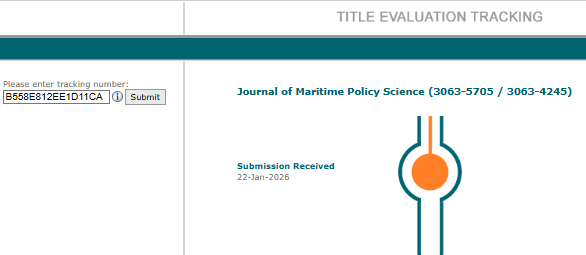
We are pleased to inform you that the Journal of Maritime Policy Science (JMPS) has been submitted for Scopus Evaluation. This step reflects our ongoing commitment to strengthening the journal’s international visibility, publication quality, and scholarly impact in the fields of maritime policy, governance, and related studies.

Please note that registration/submission to Scopus means our journal is currently under the Scopus evaluation process, and the final decision will be determined by the Scopus Content Selection & Advisory Board (CSAB). We will share official updates with our authors and readers as soon as there is progress or an outcome from the evaluation.

Authors and stakeholders can monitor the evaluation status via the Scopus Progress Tracker: https://suggestor.step.scopus.com/progressTracker/?trackingID=B558E812EE1D11CA 


We sincerely thank all authors, reviewers, editors, and partners for your continued support and contribution to improving JMPS. We encourage you to keep submitting high-quality manuscripts and to uphold rigorous academic and ethical standards in every publication.

Warm regards,
Editorial Team
Journal of Maritime Policy Science (JMPS)
Read more about JMPS in the Process of Scopus Indexing !!!

Current Issue

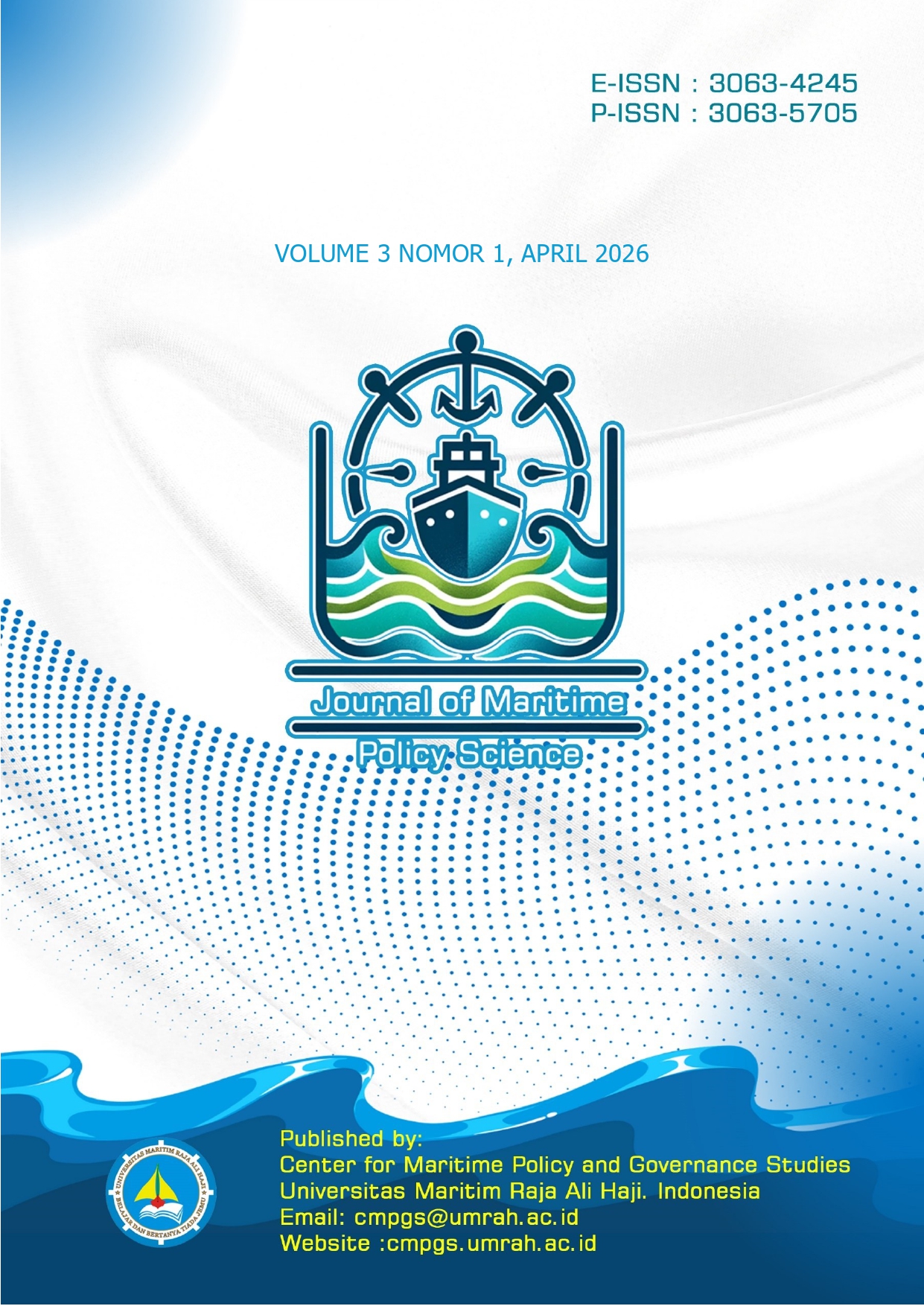
Vol. 3 No. 1 (2026): April, 2026
					View Vol. 3 No. 1 (2026): April, 2026

The first article, Port Governance and Bureaucratic Challenges: A Literature Review of Regulatory Reform in the Indonesian Maritime Sector, examines the relationship between port governance, bureaucratic complexity, and regulatory reform within Indonesia’s maritime sector. The article highlights how fragmented authority, administrative procedures, and overlapping regulations can affect the effectiveness of port management. Through a literature review approach, the study emphasizes the need for more adaptive, integrated, and transparent governance to improve maritime service delivery and strengthen national port competitiveness. The second article, Disharmony Between National and Regional Policies in Maritime Governance: A Case Study of Tanjungpinang City Port, explores the policy gaps between central and regional authorities in managing maritime governance at Tanjungpinang City Port. The authors discuss how differences in regulatory interpretation, institutional authority, and local implementation capacity may create governance challenges. This article provides important insights into the need for stronger coordination, clearer authority distribution, and policy synchronization between national and regional levels. The third article, Challenges in Implementing Maritime Development in Indonesia: From Concept to Reality, discusses the gap between maritime development planning and its practical implementation in Indonesia. The article addresses various challenges, including infrastructure limitations, institutional coordination, funding constraints, and policy execution. The study underlines that maritime development requires not only strong policy concepts but also consistent implementation, cross-sector collaboration, and sustainable governance mechanisms. The fourth article, Sea Level Rise in Indonesia and Legal Certainty of Sea Territory: Implications of the ICJ Advisory Opinion of 23 July 2025 Under UNCLOS 1982 on Baselines and Delimitation, analyzes the legal implications of sea level rise for Indonesia’s maritime territory, particularly in relation to baselines and maritime boundary delimitation under UNCLOS 1982. The article discusses how climate change may affect legal certainty over sea territories and examines the relevance of the ICJ Advisory Opinion of 23 July 2025. This study contributes to the broader debate on maritime law, climate change, and the protection of archipelagic state interests. The final article, Financing the Missing Middle: A Systematic Review of Constraints and Solutions for SMEs in Tanzania’s Blue Economy, reviews the financing challenges faced by small and medium enterprises within Tanzania’s blue economy sector. The article focuses on the “missing middle” financing gap, where SMEs often struggle to access suitable financial support despite their role in economic development. Through a systematic review, the study identifies key constraints and potential solutions to strengthen inclusive financing, business sustainability, and blue economy growth.


Enjoy Reading!!

Published: 2026-04-25
View All Issues
Journal Title : Journal of Maritime Policy Science
Initial : JMPS
Frequency : 3 issues to year (April, August, December)
DOI : 10.31629/jmps
Print ISSN : 3063-5705
Online ISSN : 3063-4245
Responsible : Dr. Alfiandri, S.Sos., M.Si.
Editor in Chief : Dr. Yudithia, S.STP., SH., MP., M.Si.
Publisher : Center for Maritime Policy and Governance Studies.
Universitas Maritim Raja Ali Haji. Indonesia
Citation Analysis : Google Scholar
Index : Garba Rujukan Digital
Website : https://ojs.umrah.ac.id/index.php/jmps
Email : [email protected]

Interested in submitting to this journal? We recommend that you review the About the Journal page for the journal's section policies, as well as the Author Guidelines. Authors need to register with the journal prior to submitting or, if already registered, can simply log in and begin the five-step process.

To authors, we ask to be careful of false promises or sending Letters of Acceptance (LoA) related to this journal. All correspondence and sending notifications, including Letters of Acceptance (LoA) are carried out via the journal's official email address as stated in the contact. Authors who require consultation can contact the WhatsApp number listed, but we do not send notifications or LoA via this contact or other WhatsApp numbers. Thank You