Chemical Oxygen Demand (COD) Reduction and Electricity Generation of Unila Retention Pond Water Treatment Using Microbial Fuel Cells (MFCs)
Keywords:
Unila retention pond water, Stacked MFCs, water treatment, electricity generationAbstract
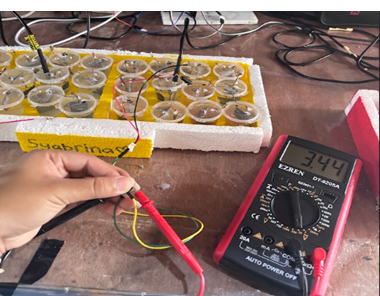
Unila retention pond water not only received stormwater but also greywater from Griya Kencana’s drainage outlet. It might drive the to water quality degradation. Hence, the stacked Microbial Fuel Cells (MFCs) were utilized to treat the water. MFC utilize microbial activities to degrade the organic pollutant in wastewater while simultaneously generating bioelectricity through biochemical reactions. In this research, the MFCs was configured in series and parallel set up with overall number of cells was 12 for each configuration. But in parallel, it consists of two set of 6 cells series set up. The reactor consisted of graphite that function as the anode and zinc to work as cathode. The spacing between electrodes was 1 cm. Each cell of MFCs was design as air cathode system. The operation of MFCs was a batch system with Hydraulic Retention Time (HRT) 7 days. The research objectives were to evaluate the capability of stacked MFCS (series and parallel) to treat the water in term of Chemical Oxygen Demand (COD) Removal and to generate electricity. The results demonstrated that the stacked MFCs had successfully treated the water with efficiency of COD removal 22.34% for series configuration and 8.51% for parallel configuration. The systems also achieved electricity generation by maximum voltage 8.11 V and 4.12 V for series and parallel respectively. Maximum current value for series MFCs was 0.14 mA and parallel MFCs was 0.15 mA.