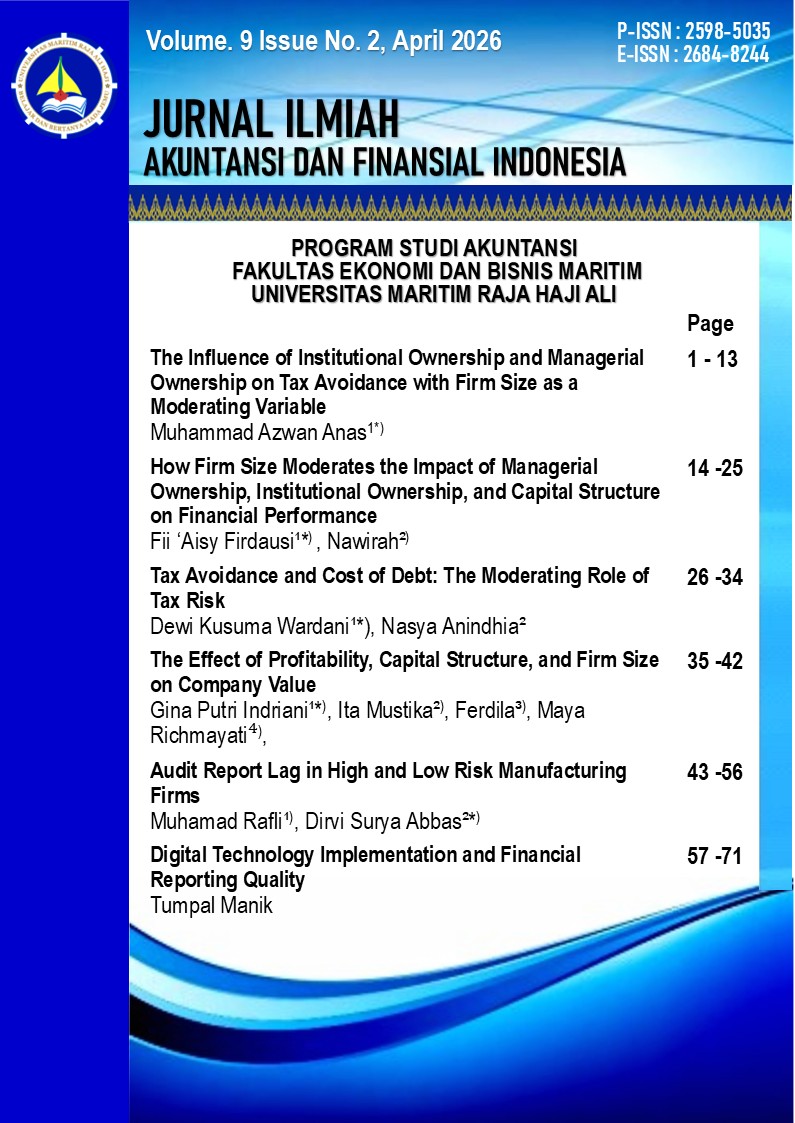
Digital Technology Implementation and Financial Reporting Quality
DOI:
https://doi.org/10.31629/9g5tca75Keywords:
Digital technology, Financial reporting quality, Digital transformation, Accounting informationAbstract
This study examines the effect of digital technology implementation on financial reporting quality among non-financial companies listed on the Indonesia Stock Exchange during the 2018–2025 period. Using a quantitative research approach, the study analyzes 3,185 firm-year observations from 455 companies. Digital technology implementation was measured through content analysis based on nine digital transformation components and 102 keyword indicators disclosed in annual reports. Financial reporting quality was proxied using the Jones Model, Dechow Model, and accounting conservatism measures. The findings indicate that digital technology implementation significantly improves financial reporting quality by enhancing internal control effectiveness, reducing information asymmetry, limiting earnings management practices, and increasing reporting transparency and reliability. The results further reveal that audit quality, firm age, and company growth positively influence financial reporting quality, whereas leverage, loss conditions, and the COVID-19 pandemic negatively affect reporting quality. Overall, this study provides empirical evidence that digital transformation plays an important role in strengthening the quality, credibility, and transparency of corporate financial reporting.
Downloads
References
Abuhassna, H., & Alnawajha, S. (2023). The Transactional Distance Theory and Distance Learning Contexts: Theory Integration, Research Gaps, and Future Agenda. Education Sciences, 13(2), 112. https://doi.org/10.3390/educsci13020112
ACFE. (2020). Association of Certified Fraud Examiners, Survei Fraud Indonesia. https://acfe-indonesia.or.id/survey-fraud-indonesia-2019/
ACFE. (2022). Occupational Fraud 2022: A Report to the Nations,. Association of Certified Fraud Examiners. https://acfepublic.s3.us-west-2.amazonaws.com/2022+Report+to+the+Nations.pdf
Alsmady, A. A. (2022). Quality of financial reporting, external audit, earnings power and companies performance: The case of Gulf Corporate Council Countries. Research in Globalization, 5, 100093. https://doi.org/10.1016/j.resglo.2022.100093
BinSaeed, R. H., Yousaf, Z., Grigorescu, A., Radu, V., & Nassani, A. A. (2023). Digital Revolution and Digitization Process to Promote AIS as a Vector of Financial Performance. Systems, 11(7), 339. https://doi.org/10.3390/systems11070339
Chen, N., Sun, D., & Chen, J. (2022). Digital transformation, labour share, and industrial heterogeneity. Journal of Innovation & Knowledge, 7(2), 100173. https://doi.org/10.1016/j.jik.2022.100173
Chen, Y., Shen, L., Bian, Y., & Zhang, X. (2023). Effects of Digital Transformation on Dynamic Capital Structure Adjustment: Evidence from China. Systems, 11(7), 330. https://doi.org/10.3390/systems11070330
Dechow, M. P. ., Sloan, G. R., & Sweeney, P. A. (1995). Detecting Earnings Management. The Accounting Review, 70(2), 193-225 (33 pages). https://www.jstor.org/stable/248303
DeFond, M., & Zhang, J. (2014). A review of archival auditing research. Journal of Accounting and Economics, 58(2–3), 275–326. https://doi.org/10.1016/j.jacceco.2014.09.002
Deng, Q., & Noorliza, K. (2023). Integration, Resilience, and Innovation Capability Enhance LSPs’ Operational Performance. Sustainability, 15(2), 1019. https://doi.org/10.3390/su15021019
Dong, T., Yin, S., & Zhang, N. (2023). The Interaction Mechanism and Dynamic Evolution of Digital Green Innovation in the Integrated Green Building Supply Chain. Systems, 11(3), 122. https://doi.org/10.3390/systems11030122
DSAK IAI. (2021). Standar Akuntansi Keuangan (SAK) Entitas Privat. https://web.iaiglobal.or.id/SAK-IAI/Produk SAK Entitas Privat Disahkan#gsc.tab=0
Fang, Q., Yu, N., & Xu, H. (2023). Governance effects of digital transformation: from the perspective of accounting quality. China Journal of Accounting Studies, 11(1), 77–107. https://doi.org/10.1080/21697213.2023.2148944
Gao, X. (2023). Digital transformation in finance and its role in promoting financial transparency. Global Finance Journal, 58, 100903. https://doi.org/10.1016/j.gfj.2023.100903
Gebauer, H., Fleisch, E., Lamprecht, C., & Wortmann, F. (2020). Growth paths for overcoming the digitalization paradox. Business Horizons, 63(3), 313–323. https://doi.org/10.1016/j.bushor.2020.01.005
Guo, X., Li, M., Wang, Y., & Mardani, A. (2023). Does digital transformation improve the firm’s performance? From the perspective of digitalization paradox and managerial myopia. Journal of Business Research, 163, 113868. https://doi.org/10.1016/j.jbusres.2023.113868
Hasan, M. S. (2023). The impact of digital transformation on the quality of financial reports a field study in a sample of banks listed in tHasan, M. S. (2023). The impact of digital transformation on the quality of financial reports a field study in a sample of banks listed . American Journal of Business Management, Economics and Banking, 8(1), 101–120. https://americanjournal.org/index.php/ajbmeb/article/view/377
Heredia, J., Castillo-Vergara, M., Geldes, C., Carbajal Gamarra, F. M., Flores, A., & Heredia, W. (2022). How do digital capabilities affect firm performance? The mediating role of technological capabilities in the “new normal.” Journal of Innovation & Knowledge, 7(2), 100171. https://doi.org/10.1016/j.jik.2022.100171
Hermanns, S. (2006). Financial Information and Earnings Quality: A Literature Review. SSRN Electronic Journal. https://doi.org/10.2139/ssrn.897722
Hess, T., Matt, C., Benlian, A., & Wiesböck, F. (2020). Options for Formulating a Digital Transformation Strategy. In Strategic Information Management (pp. 151–173). Routledge. https://doi.org/10.4324/9780429286797-7
Hinterhuber, A., Vescovi, T., & Checchinato, F. (2021). Managing Digital Transformation (A. Hinterhuber, T. Vescovi, & F. Checchinato (eds.)). Routledge. https://doi.org/10.4324/9781003008637
Huang, D. Z. (2022). An integrated theory of the firm approach to environmental, social and governance performance. Accounting & Finance, 62(S1), 1567–1598. https://doi.org/10.1111/acfi.12832
IASB. (2018). International Accounting Standards Board Conceptual Framework for Financial Reporting. IFRS Foundation, FRS Founda. https://www.ifrs.org/content/dam/ifrs/publications/pdf-standards/english/2021/issued/part-a/conceptual-framework-for-financial-reporting.pdf
Jensen, M. C., & Meckling, W. H. (1976). Theory of the firm: Managerial behavior, agency costs and ownership structure. Journal of Financial Economics, 3(4), 305–360. https://doi.org/10.1016/0304-405X(76)90026-X
Ji, H., Miao, Z., Wan, J., & Lin, L. (2022). Digital transformation and financial performance: the moderating role of entrepreneurs’ social capital. Technology Analysis & Strategic Management, 1–18. https://doi.org/10.1080/09537325.2022.2118110
Jones, J. J. (1991). Earnings Management During Import Relief Investigations. Journal of Accounting Research, 29(2), 193. https://doi.org/10.2307/2491047
Kane, G. C., Palmer, D., Phillips, A. N., Kiron, D., & Buckley, N. (2015). Strategy, not Technology, Drives Digital Transformation (MIT Sloan Management (ed.)). Delote University Press. http://sloanreview.mit.edu/topic/digital
Kong, D., & Liu, B. (2023). Digital Technology and Corporate Social Responsibility: Evidence from China. Emerging Markets Finance and Trade, 59(9), 2967–2993. https://doi.org/10.1080/1540496X.2023.2199122
Kraus, S., Jones, P., Kailer, N., Weinmann, A., Chaparro-Banegas, N., & Roig-Tierno, N. (2021). Digital Transformation: An Overview of the Current State of the Art of Research. SAGE Open, 11(3), 215824402110475. https://doi.org/10.1177/21582440211047576
Krisko, A. (2017). The role of resistance in incorporating XBRL into financial reporting practices. International Journal of Accounting and Economics Studies, 5(2), 100. https://doi.org/10.14419/ijaes.v5i2.7981
Kusnadi, Y., Leong, K. S., Suwardy, T., & Wang, J. (2016). Audit Committees and Financial Reporting Quality in Singapore. Journal of Business Ethics, 139(1), 197–214. https://doi.org/10.1007/s10551-015-2679-0
Mahdi Sahi, A., Mahdi Sahi, A., Abbas, A. F., & F. A. Khatib, S. (2022). Financial reporting quality of financial institutions: Literature review. Cogent Business & Management, 9(1). https://doi.org/10.1080/23311975.2022.2135210
Majdalawieh, M., & Khan, S. (2022). Building an Integrated Digital Transformation System Framework: A Design Science Research, the Case of FedUni. Sustainability, 14(10), 6121. https://doi.org/10.3390/su14106121
Manita, R., Elommal, N., Baudier, P., & Hikkerova, L. (2020). The digital transformation of external audit and its impact on corporate governance. Technological Forecasting and Social Change, 150, 119751. https://doi.org/10.1016/j.techfore.2019.119751
Muraina, S. A., & Dandago, K. I. (2020). Effects of implementation of International Public Sector Accounting Standards on Nigeria’s financial reporting quality. International Journal of Public Sector Management, 33(2/3), 323–338. https://doi.org/10.1108/IJPSM-12-2018-0277
Nadkarni, S., & Prügl, R. (2021). Digital transformation: a review, synthesis and opportunities for future research. Management Review Quarterly, 71(2), 233–341. https://doi.org/10.1007/s11301-020-00185-7
Pargmann, J., Riebenbauer, E., Flick-Holtsch, D., & Berding, F. (2023). Digitalisation in accounting: a systematic literature review of activities and implications for competences. Empirical Research in Vocational Education and Training, 15(1), 1. https://doi.org/10.1186/s40461-023-00141-1
Peng, Y., & Tao, C. (2022). Can digital transformation promote enterprise performance? —From the perspective of public policy and innovation. Journal of Innovation & Knowledge, 7(3), 100198. https://doi.org/10.1016/j.jik.2022.100198
Quiros, E. (2022). Digital Transformation and the Role of Accounting and Finance Professionals in this New Era. International Federation of Accountants (IFAC). file:///C:/Users/tmany/Downloads/IMA-IFAC-PG-Case-Study-Digital-Transformation-Accountants.pdf
Rahwani, N. R., Sadewa, M. M., Qalbiah, N., Mukhlisah, N., Artha W, P., & Nikmah, N. (2019). XBRL based Corporate Tax Filing in Indonesia. Procedia Computer Science, 161, 133–141. https://doi.org/10.1016/j.procs.2019.11.108
Rajabalinejad, M. (2018). System Integration: Challenges and Opportunities for Rail Transport. 2018 13th Annual Conference on System of Systems Engineering (SoSE), 471–476. https://doi.org/10.1109/SYSOSE.2018.8428760
Reis, J., Amorim, M., Melão, N., & Matos, P. (2018). Digital Transformation: A Literature Review and Guidelines for Future Research (pp. 411–421). https://doi.org/10.1007/978-3-319-77703-0_41
Robertsone, G., & Lapiņa, I. (2023). Digital transformation as a catalyst for sustainability and open innovation. Journal of Open Innovation: Technology, Market, and Complexity, 9(1), 100017. https://doi.org/10.1016/j.joitmc.2023.100017
Saarikko, T., Westergren, U. H., & Blomquist, T. (2020). Digital transformation: Five recommendations for the digitally conscious firm. Business Horizons, 63(6), 825–839. https://doi.org/10.1016/j.bushor.2020.07.005
SAK. (2015). Standar Akuntansi Keuangan Per Efektif 1 Januari 2015. Ikatan Akuntan Indonesia (IAI), 2–16.
Shakespeare, C. (2020). Reporting matters: the real effects of financial reporting on investing and financing decisions. Accounting and Business Research, 50(5), 425–442. https://doi.org/10.1080/00014788.2020.1770928
Sklyar, A., Kowalkowski, C., Sörhammar, D., & Tronvoll, B. (2019). Resource integration through digitalisation: a service ecosystem perspective. Journal of Marketing Management, 35(11–12), 974–991. https://doi.org/10.1080/0267257X.2019.1600572
Thuy, T. V. V., Dang Ngoc, H., Nguyen Ngoc, T., & Anh Le, H. (2022). Earnings quality and the cost of debt: A case study of Vietnam. Cogent Business & Management, 9(1). https://doi.org/10.1080/23311975.2022.2140489
Treisman, A. M., & Gelade, G. (1980). A feature-integration theory of attention. Cognitive Psychology, 12(1), 97–136. https://doi.org/10.1016/0010-0285(80)90005-5
Vial, G. (2019). Understanding digital transformation: A review and a research agenda. The Journal of Strategic Information Systems, 28(2), 118–144. https://doi.org/10.1016/j.jsis.2019.01.003
Warner, K. S. R., & Wäger, M. (2019). Building dynamic capabilities for digital transformation: An ongoing process of strategic renewal. Long Range Planning, 52(3), 326–349. https://doi.org/10.1016/j.lrp.2018.12.001
Weerasinghe, L., & Nirere, B. (2022). No TitleChallenges of digital transformation [Umea University]. https://www.diva-portal.org/smash/get/diva2:1709073/FULLTEXT01.pdf
Wu, M., & Abeysekera, I. (2023). Financial reporting quality of ESG firms listed in China. PLOS ONE, 18(6), e0284684. https://doi.org/10.1371/journal.pone.0284684
Zhu, X., Ge, S., & Wang, N. (2021). Digital transformation: A systematic literature review. Computers & Industrial Engineering, 162, 107774. https://doi.org/10.1016/j.cie.2021.107774
Downloads
Published
Issue
Section
License
Copyright (c) 2026 Jurnal Ilmiah Akuntansi dan Finansial Indonesia (JIAFI)

This work is licensed under a Creative Commons Attribution-NonCommercial 4.0 International License.